The Tinkerer
Building things was never a project. It was a habit.

Experimental Hovercraft
Using a discarded microlight engine and a flat-bottom aluminium boat, Vivek built a working hovercraft. He tested it on Khadakwasla Lake. It moved. It hovered. It was, as he described it, an interesting project.

The Windmill
He built his own wind turbine using the free open-source plans of the Scottish engineer Hugh Piggott — adapted, adjusted, and refined. The blades were hand-carved from pine salvaged from packing crates. The turbine has generated electricity at his farmhouse for years. He installed one of his windmills at a Buddhist Monastery in Spiti at a height of 15000 ft, the highest installation in the world.

Solar Water Pump
The Atom Solar water pump is the project that reached beyond the workshop.
Designed for small farmers in rain-deficient regions, it is a 1HP submersible pump powered by a portable 1,200-watt solar panel array. Cost: approximately one lakh rupees — a fraction of the alternatives. Maintenance: near zero. Dependence on the electricity grid: none.
In 2013, the Atom Solar pump won the Greenpeace Innovation Challenge — beating entries from the IITs, MIT, and Stanford. Through an NGO, it was subsequently installed across farmland in Maharashtra and deployed to forty smallholder farms in Nepal's Terai region, where it enabled women farmers to grow three crops a year instead of one.
Vivek also designed a portable trolley to carry the solar panels between fields — so a farmer could loan it to neighbours and recover the investment in less than a year.

The Aerial Photography Rig
He carried a camera for aerial photography using his paramotor setup. The photographs are taken from altitude, in flight.

Electric Mobility
He assembled his own electric bicycle. He rides it every morning, uphill, past neighbours on racing bikes. He is generally faster.
The Aerial Photography Rig
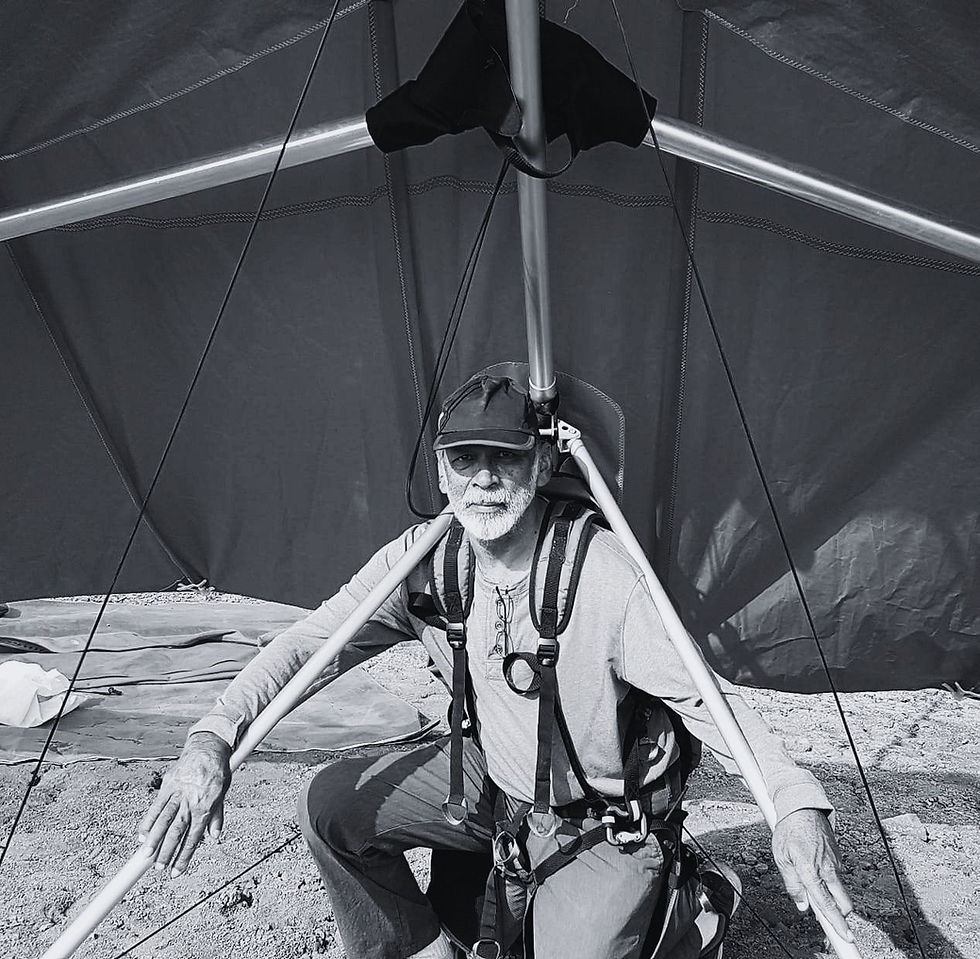
The first glider was built in 1975–76 from aluminium pipes sourced from a Pune market and fertilizer bag fabric. It flew.
Over the following decade, he built twenty-five more training gliders for the CME Hang Gliding School. Each one was constructed, tested, adjusted, and rebuilt as the design evolved through practice.
In later years he built his own paramotor — a motorised backpack that allows a paraglider pilot to fly from flat ground. He assembles, strips, rebuilds, and adjusts his flying equipment continuously. The workshop is never finished with any one machine.
.jpg)
The Builder's Mindset
Engineering the Impossible
Vivek Mundkur has always made things. Not for recognition, not for commercial purpose, and not because the technology did not exist. He makes things because making is how he thinks. A problem appears. He turns it over. He draws something on paper. He goes to the workshop. He builds.
The results, over six decades, form a remarkable list — not of inventions, but of solutions. Each one answers a real question with a practical object constructed largely by hand, from available materials, in the workshop of his farmhouse near Khadakwasla Lake.
"Kids need the freedom to explore, innovate, and occasionally get a little bruise. That is the price of exploration."
— Lt Col Vivek Mundkur (Retd)
Closing note
These are not listed here as achievements. They are listed because they form a picture of a particular kind of mind — restless, practical, uninterested in problems it cannot help solve, and entirely comfortable with the gap between idea and finished object. That gap is where Vivek lives.